


How to Build a Top 5 Stretches for Thoracic Spine Mobility Routine

Last Updated: October 30, 2026
Quick Summary
The top 5 stretches for thoracic spine mobility are Cat-Cow, Thread the Needle, supine knee rolls and Iron Cross, foam roller thoracic extension, and towel and quadruped extension. Pair one extension movement with one rotation movement, and start with two or three exercises before adding more.
Cat-Cow is performed for 8 to 10 slow reps and can be done daily.
Thread the Needle is held for 20 to 30 seconds per side, 4-5 days a week.
Foam roller extension calls for 5-8 slow reps, 3-4 days a week.
Keep hips square during Thread the Needle so rotation comes from the mid-back.
If a movement fails the screen, use the easier version for two to three weeks, then retest.
Table of Contents
1. Cat-Cow: The Foundational Thoracic Spine Mobility Exercise
2. Thread the Needle: A Thoracic Rotation Stretch for Stiff Mid-Backs
3. Supine Knee Rolls and Iron Cross: Lying Rotation Stretches
4. Foam Roller Thoracic Extension Exercises for Segmental Mobility
5. Towel and Quadruped Thoracic Extension Exercises for Posture
Why Thoracic Spine Mobility Matters for Your Mid-Back
Your thoracic spine is the section of spine that runs through your mid-back, from the base of your neck to the bottom of your rib cage. It is built for rotation and extension, yet most of us spend the day locked in the opposite position: hunched over a laptop, curled on a couch, or slumped in a car seat.
That mismatch has consequences. When the mid-back stiffens, the neck and lower back often pay for it, because they get recruited to do movement the thoracic spine no longer handles well. Many people describe this as a general "back stiffness" that never quite resolves, even after rest.
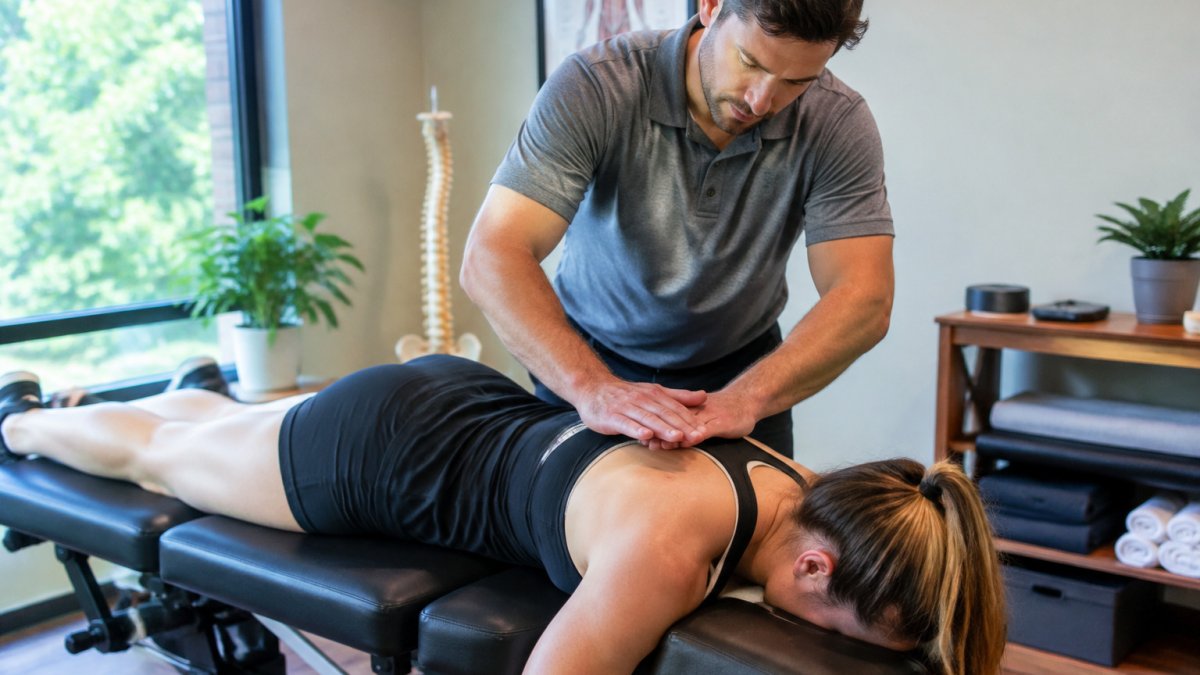
Mid-back stiffness often traces back to long hours at a desk or to injuries such as motor vehicle accidents. A clinical evaluation can help show how spinal mechanics connect to symptoms before any stretch is recommended.
Here is the key point most guides skip: thoracic mobility is not the same as shoulder mobility or lumbar mobility. Each region moves differently, and stretches need to target the right segment.
How to Choose the Right Stretches for Your Mid-Back
The best thoracic spine mobility exercises share three traits: they move the mid-back itself, they stay pain-free, and they match your current ability. A stretch that feels like a sharp catch is not working for you, it is working against you.
We choose stretches using four filters:
Targets the thoracic spine, not just the shoulders or low back
Uses controlled movement rather than bouncing or forcing
Fits your level, with an easier version available
Can be done consistently, ideally daily
A common mistake is chasing the deepest stretch possible. Range of motion improves through repeated, gentle work, not one aggressive session.
Why These Five Stretches
The five stretches below cover the three main jobs the thoracic spine performs, and each can be scaled from a beginner version to a more advanced one without special equipment.
Movement job | What it means | Stretch that covers it |
Extension | Opening the mid-back after slumping | Cat-Cow, foam roller extension, towel extension |
Rotation | Turning and reaching without twisting the low back | Thread the Needle, supine knee rolls and Iron Cross |
Control | Moving one segment without the neck or low back taking over | Cat-Cow tempo work, quadruped extension |
If you only have time for two, pick one extension movement and one rotation movement. That pairing addresses the two directions most desk workers lose first. Add the control work once the basic range feels comfortable.
Thoracic Versus Shoulder and Lumbar Movement
A stretch only counts as thoracic work if the mid-back moves and the neighboring regions stay quiet. Before you count a rep, check three things:
Low back: the arch should come from the rib cage area, not from dumping into the lumbar spine. If your beltline moves more than your bra line or shoulder blades, you are compensating.
Neck: the chin should stay gently tucked in extension and the head should not jut forward to create range.
Shoulders: in rotation drills, the shoulder blade should glide, not jam. If the front of the shoulder pinches, reduce the reach.
A simple test: place one hand on your sternum and one on your belly. During a Cat-Cow or Thread the Needle, the hand on the sternum should feel the rib cage move while the belly hand stays relatively still. If the belly hand moves first, you are hinging at the low back.
Pro Tip Film one set from the side with your phone. Most people cannot feel the difference between mid-back extension and low-back arch until they see it.
Matching the Stretch to Your Starting Point
Use this quick screen to decide where to begin. It is not a diagnosis, just a way to pick a starting dose.
Can you sit tall in a chair and rotate your rib cage 45 degrees each way without moving your hips? If not, start with seated Cat-Cow and supine knee rolls before loading quadruped work.
Can you lie on a foam roller at the mid-back and extend without your ribs flaring or your low back arching? If not, use the towel version first and keep the range small.
Can you reach one arm forward in quadruped without your hips shifting? If not, practice the control drill before adding Thread the Needle depth.
If a movement fails the screen, that is not a reason to avoid it forever. It is a signal to use the easier version for two to three weeks, then retest.
1. Cat-Cow: The Foundational Thoracic Spine Mobility Exercise
Cat-Cow is the starting point for most thoracic mobility routines because it teaches the spine to flex and extend through a controlled range. It warms up the mid-back and helps you feel where movement is restricted. (Source: guidelines for physical activity)

How to Perform Cat-Cow
Start on hands and knees in a quadruped position, wrists under shoulders and knees under hips.
Inhale and let your belly drop, lifting your chest and tailbone into extension.
Exhale and round your mid-back toward the ceiling, tucking your chin gently.
Move slowly, one segment at a time, and breathe through each rep.
Complete 8 to 10 slow reps.
Beginner and Advanced Modifications
Beginners can do seated Cat-Cow in a chair, moving the mid-back while keeping hips still. Advanced versions add a slight pause at the top of each arch, or slow the tempo to build control.
2. Thread the Needle: A Thoracic Rotation Stretch for Stiff Mid-Backs
Thread the Needle is a thoracic rotation stretch performed from a quadruped position that many people use to open a stiff mid-back. It combines rotation with a gentle reach, which makes it a reliable choice for desk workers.
Step-by-Step Instructions
Begin in a quadruped position.
Slide your right arm under your body, palm up, and lower your right shoulder toward the floor.
Reach your left arm forward and let your mid-back rotate.
Hold for 20 to 30 seconds, breathing slowly.
Return to center and repeat on the other side.
Common Mistakes to Avoid
The biggest error is rotating from the low back instead of the thoracic spine. Keep your hips square and let the movement come from the mid-back. Watch out: forcing the shoulder to the floor before the spine is ready can irritate the shoulder joint.
3. Supine Knee Rolls and Iron Cross: Lying Rotation Stretches
Lying rotation stretches let you control the movement with the floor supporting your spine. Supine knee rolls and the Iron Cross stretch both target thoracic rotation while keeping the low back supported.
For knee rolls, lie on your back with knees bent, then let both knees fall slowly to one side while keeping shoulders down. Hold, breathe, and switch sides. The Iron Cross adds an arm reach across the body for a deeper twist.
These work well on days when your back feels sensitive, because gravity does less of the work. Keep the range small at first.
4. Foam Roller Thoracic Extension Exercises for Segmental Mobility
Foam roller thoracic extension exercises target segmental mobility, meaning movement at individual spinal segments rather than the whole mid-back at once. This makes them useful for stiffness that feels concentrated in one spot.
How to Use a Foam Roller Safely
Place the roller horizontally under your mid-back.
Support your head with your hands and keep your hips on the floor.
Gently extend over the roller, then return.
Move the roller slightly with each rep to work different segments.
Keep the motion small and controlled.
Watch out: rolling too high into the neck or forcing a deep arch can cause pain. Stay in your pain-free range and stop if you feel sharp discomfort.
5. Towel and Quadruped Thoracic Extension Exercises for Posture
A rolled towel and a few quadruped movements can improve thoracic extension at home with no equipment beyond what you already own. These are useful for posture, especially after long stretches of sitting.
Lie on your back with a rolled towel under your mid-back and let your chest open gently over it. From a quadruped position, you can also practice controlled extension by reaching one arm forward while keeping the ribs down. Both help restore extension that slumping takes away.
Building a Weekly Thoracic Mobility Routine With Dosage
A practical thoracic mobility routine works best with clear dosage: how often, how long, and how many reps. We suggest the following structure, adjusted to your comfort.
Exercise | Hold or Reps | Frequency | Focus |
Cat-Cow | 8-10 reps | Daily | Flexion and extension |
Thread the Needle | 20-30 sec per side | 4-5 days a week | Thoracic rotation |
Supine knee rolls | 20-30 sec per side | Daily | Gentle rotation |
Foam roller extension | 5-8 slow reps | 3-4 days a week | Segmental mobility |
Towel extension | 1-2 minutes | Daily | Posture and extension |
Start with two or three exercises and add more as your mid-back loosens. If stiffness persists despite consistent work, it may be worth a professional evaluation. You can request an appointment with our team, or read more about Dr. John Bialecki before you book.
Stubborn mid-back stiffness rarely resolves on its own, especially when it follows an injury or years of desk work. At BialeckiChiropractic, our board-certified chiropractor brings advanced training in whiplash biomechanics and injury traumatology, plus expertise in spinal biomechanical engineering, to find what is actually driving your symptoms. We build care around your specific spinal mechanics, not a generic template. Get started with BialeckiChiropractic and take the first step toward a mid-back that moves the way it should.
Frequently Asked Questions
How often should you do thoracic spine mobility exercises?
Most people can perform thoracic spine mobility exercises daily or at least four to five times per week. A short session of five to ten minutes is enough to maintain spinal range of motion. If you are new to mobility work, start with three sessions per week and increase as your mid-back stiffness improves. Stop if you feel sharp pain, and speak with a clinician before progressing if you have a known spinal condition or recent injury.
How long should you hold a thoracic spine stretch?
Hold static thoracic rotation stretches such as Thread the Needle or the supine knee roll for 20 to 30 seconds and repeat two to three times per side. Dynamic movements like Cat-Cow work better with a slow, controlled pace of about five to eight seconds per direction for eight to ten repetitions. Breathe steadily throughout the hold and stay within a pain-free range rather than pushing into discomfort.
Can thoracic mobility exercises help with mid-back stiffness?
Thoracic mobility work is commonly included in routines aimed at reducing mid-back stiffness. Consistency generally matters more than intensity for managing back stiffness over time.
When should you stop a thoracic mobility stretch?
Stop immediately if you feel sharp pain, numbness, tingling, or pain that travels into the arms or legs. A mild stretch sensation is normal; a burning or shooting feeling is not. If mid-back stiffness persists beyond a few weeks of consistent mobility work, or if you have had a recent motor vehicle accident, a fall, or a whiplash-type injury, a professional evaluation can identify whether the thoracic spine is the source or whether the shoulder or lumbar spine needs attention first.


Comments